
Diamond Buying Guide
Contents
1. Loose Diamonds/Diamond Jewelry 2. Ideal Cut Diamonds 3. Heart and Arrow cuts 4. Brilliance, Dispersion and Scintillation define a diamonds beauty 5. Diamond Color 6. Diamond Clarity 7. Diamond Carat Weight 8. What Is The Right Diamond Size For Me?Loose Diamonds/Diamond Jewelry
Before you buy a diamond, make sure you ask your jeweller about its 4 key aspects. While every gem catches your eye with its brilliance, all diamonds share certain attributes that allow their comparison and evaluation. These features are commonly know as the 4Cs.
They stand for
• Cut
• Color
• Clarity
• Carat Weight
Before you select and buy a diamond, it is advisable to learn about this fascinating gemstone, so that you understand which features contribute to its lasting beauty and value.
Ideal Cut Diamonds
When a diamond’s cut is perfectly proportioned to within very tight size tolerances and features perfect symmetry, finish and polish it is an ‘Ideal Cut’. Due to this, light performs better within the diamond. Enhancing its brilliance, fire and scintillation and making it stand. A special sub category of ideal cut diamonds are the Hearts and Arrow diamonds for their unique shapes.
Hearts and Arrows Diamonds
Hearts and Arrow cuts are round brilliant cut diamonds that are cut to very precise tolerances. When looking at these diamonds from the table down, one can see a radial aligned pattern of arrows, whereas one can see 8 hearts that are placed within small “V”-shapes when looking at the diamond from the pavilion up. Since these diamonds are cut to exacting standards, they reflect and refract light to the fullest extent possible and hence are the best performing diamonds in the market.
Brilliance, Dispersion and Scintillation define a diamonds beauty
A diamond’s beauty is defined by how well it reflects and refracts light. There are three different properties present in a well-cut diamond, that define its performance: Brilliance, scintillation and dispersion.
Brilliance is essentially light that enters a diamond and that gets nearly entirely reflected.
When a light ray enters a diamond and gets broken into the spectrum colors, then the resulting phenomenon is called dispersion or “fire”.
Scintillation can be described as flashes of reflected light emanating from a diamond’s polished facets that are observed when either the diamond, or light source, or the onlooker is moving. Scintillation is often referred to as “sparkle”.
Diamond Color
The color of a white diamond is graded on a scale from D-Z; D representing the colorless side of the scale, whereas Z marks the end point of the light yellow color range. The scale is subdivided into five main groups:
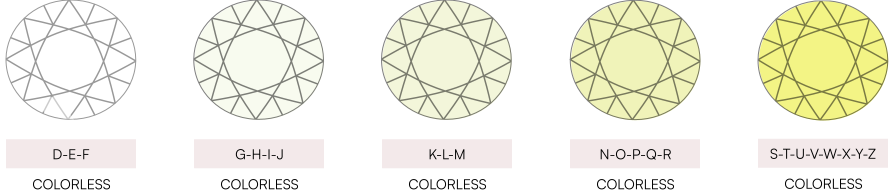
D-F representing the colorless range:
Diamonds in this color range are the most rare and most thought-after on the color scale. D and E color diamonds are colorless whereas F color diamonds display a very faint trace of color when viewed by a gemologist face down. Diamonds in the colorless range benefit from being set in white gold or platinum, since the white metal color promotes the whiteness of the diamond; whereas when set in yellow gold the diamond would look more yellow than it actually is.
G-J representing the near colorless range:
Diamonds in this color range look colorless when viewed from top, but display a minute amount of color when inspected against a white background in the face down position. The color is not noticeable for an untrained observer once the diamond is placed into its setting. In terms of value for money, near colorless diamonds represent a great value proposition.
K-M representing the faint color range:
Diamonds in this color range might display a slight amount of color, if the diamond is viewed in the face up position. In the face-down position a faint color is visiblen even to the untrained onlooker. These diamonds are best set in yellow gold, since the color of the gold reflected into the diamonds and the diamond’s own body color are a good match. The predominant body color of white diamonds is yellow, however some diamonds take on a brown color hint, which is a result of structure related, internal graining in combination with trace elements of nitrogen.
Diamond Clarity
Natural diamonds are the result of carbon exposed to immense pressure and heat deep in the core of the earth. The formation process can result in a variety of internal characteristics called 'inclusions' and external characteristics called 'blemishes.' Inclusions and blemishes are referred to as ‘clarity characteristics’ and the evaluation of diamonds for clarity is standardized at 10 power magnification; meaning that the described clarity characteristics can only be observed when the diamond is view with a 10 x loupe or eye glass.
While most diamonds are not perfectly pure, the closer they come, the higher is their value. Clarity is an important value factor for a diamond, because the size, number and location of clarity characteristics impact the durability of the diamond. Even though a diamond is the hardest material on earth, it is not unbreakable. If for instance a surface-reaching feather is present in a diamond, a hard knock might cleave the diamond.
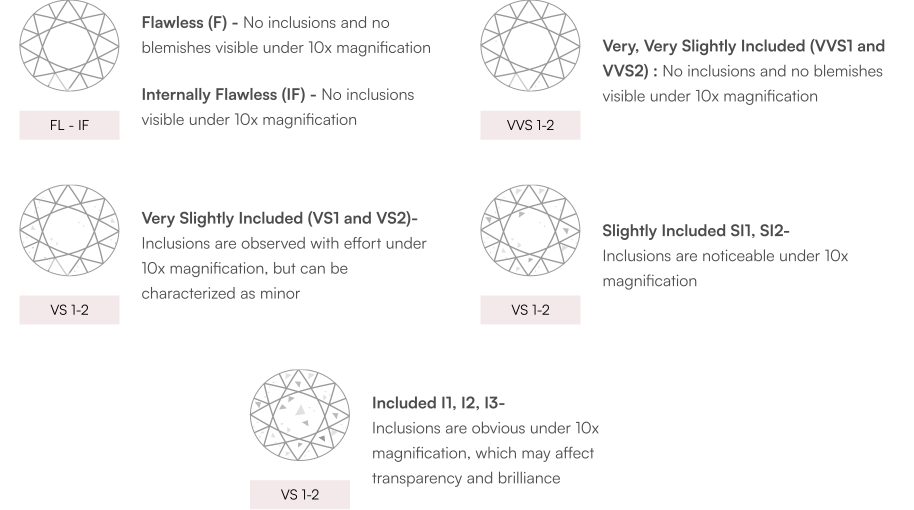
To make sure that no clarity characteristics are “eye-visible” it is advisable to select a diamond in the VS2 clarity range or higher.
Diamonds in the SI clarity range represent a great value, if the inclusion or the clarity characteristic that is present in the diamond is in an area that is covered by the setting. It is advisable to balance your preferred clarity range with a suitable color range. Commonly diamonds in the VS2 or higher clarity range are paired with D-F color range diamonds, whereas SI clarity diamonds create a good value proposition when combined with a G-I color range stone.
Most blemishes and inclusions are too small to be noticed by anyone other than a trained diamond expert. To the un-aided eye (without an eye glass), a VS and an SI diamond may look the same, but actually these diamonds are vastly different in terms of overall quality and associated value. For this reason a precise assessment of a diamond's clarity by an expert diamond grader is very important.
However, diamonds come also in other colors than white, these so called fancy color diamonds are very rare. The color of a yellow diamond is caused by trace elements of nitrogen that were present in the atmosphere when the diamond was formed. Other fancy color diamonds include green, pink, red, green and blue.
When comparing diamond colors; as a general rule, it is recommended to look at two diamonds that are at least two color grades apart, so that it is even possible to discern a color difference. Also, when looking at diamonds in the face up position, it is very difficult to make out any color difference and the color is best noticeable from the side view.
Diamond Carat Weight
Carat (with a “C”) is a measure of the weight for precious stones. One carat equals 0.20 grams. In early days of trading gemstones the dried seeds of the Carob tree were used as a standard measure of weight for diamonds and gemstones and the origin of the word “carat” can be traced back to “carob”.
In the process of cutting rough diamonds, up to 2/3 of the weight gets lost to achieve the desired shape and cut of the finished polished diamond. Considering the cutting losses and the fact that large pieces of rough in high quality are unearthed much less often than small rough diamonds, it becomes evident why for instance one 2 carat diamond costs a lot more than two 1 carat diamonds of the same quality.
When relating to the size of round diamonds, the dimension measured to establish a size to weight ratio is the diameter of the diamond. For instance, the size of a reasonably well proportioned 1 carat diamond is approximately 6.5mm. However, this doesn’t mean that a 2 carat diamond measures 13mm, (but only 8.2mm in actuality) because much of the diamond weight is attributed to the depth of the diamond.

What Is The Right Diamond Size For Me?
The choice of your diamond will be guided not only by considerations of the size, but also of the available budget. When a “bigger look” is preferred, then maybe a different diamond shape than round will provide a better size to weight ratio. For instance, marquise cut diamonds have a shallow pavilion and since less of the diamond weight is attributes to the depth of the stone, a one carat marquise cut diamond looks larger than a one carat round brilliant cut diamond. Naturally, other quality considerations, such as the color and clarity of the diamond will also guide your selection and although the carat weight is an important influencing factor for the price, it is not the only one.
Shape

Diamonds are cut into many different shapes after evaluating the available rough diamond carefully with a view to maximize its yield. Each of the shapes has its very own appeal and character. Generally speaking, the shape describes the outline contour of the diamond, such as round, oval, rectangle, square, etc. Then the specific cut defines the shape further. There are three different cut categories for diamond cuts:
Brilliant Cut
Brilliant cut diamonds have 58 facets, 33 on top and 24 at the bottom and the culet. In this cut, all 58 facets appear to radiate from the center through the top of the diamond. This is the most common diamond cut.
The round brilliant cut diamond is the most popular diamond shape, but there are also modified brilliant cuts, such as oval and pear brilliant cut diamonds, that are appreciated for their lesser common shapes.
Step Cut
Stones with outlines that are either square or rectangular and whose facets are rectilinear and arranged parallel to the girdle, are known as step- or trap-cut stones. These stones often have their corners truncated, creating an emerald cut with an octagonal outline. This corner-cutting is done, because sharp corners are points of weakness where a diamond may cleave or fracture. Instead of a culet, step-cut stones have a keel running the length of the pavilion terminus. A step cut resembles stair steps due to the three concentric rows of facets arranged around the table, culet and pavilion.
Typical representatives are the
• Emerald Cut
• The Baguette Cut
• The Asscher Cut
Mixed Cut
Mixed cut diamonds combine the facet arrangements of the step cut and brilliant cut. For instance, the crown of the diamond is cut as a brilliant cut and the pavilion as the step cut
Typical examples for mixed cuts are the
1. The Princess Cut
2. The Cushion Cut
Asscher Cut Diamonds
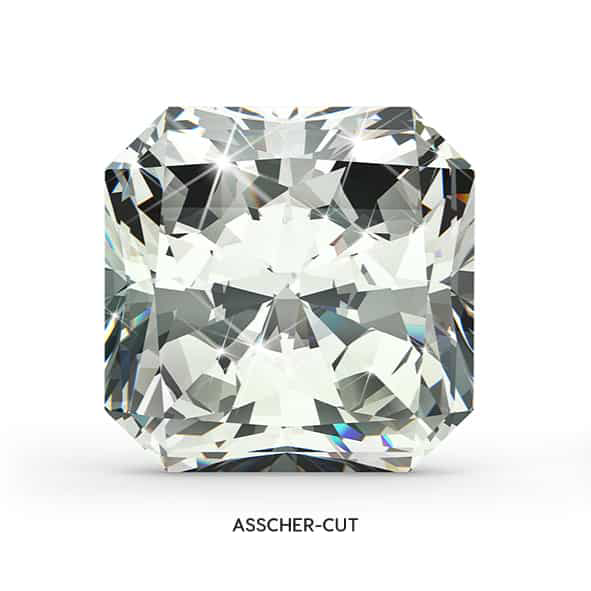
The Asscher cut, a variant of the square emerald cut, is a typical representative of a step cut diamond. The basic facet arrangement follows that of an emerald cut diamond, but the Asscher cut has a square shape with cut corners. At the first sight an Asscher cut appears to be octagonal in shape. Since inclusions and blemishes are very visible and noticeable in this cut, it is recommended to select an Asscher cut diamond with a high clarity grade.
Cushion Cut Diamonds
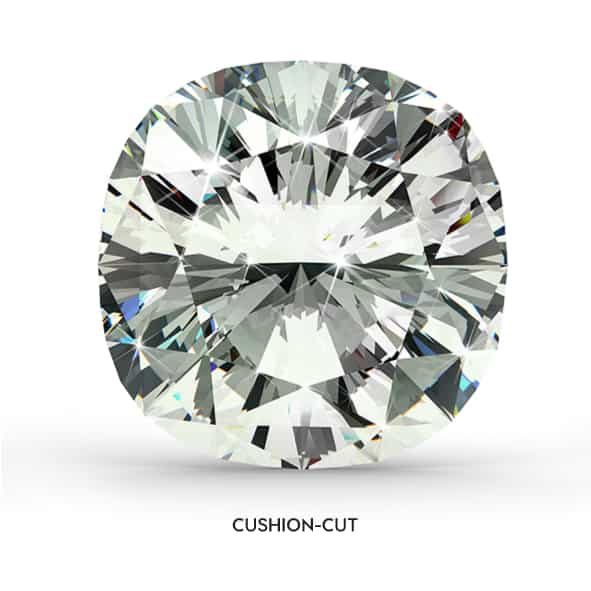
The Cushion Cut Diamond is a classic cut that has a vintage appeal. Technically speaking, it is a cut combination between an old mine cut, and a modern oval-cut diamond. A typical cushion cut features 58 facets. Its outline can be described as a square-ish oval pillow shape.
Emerald-Cut Diamonds
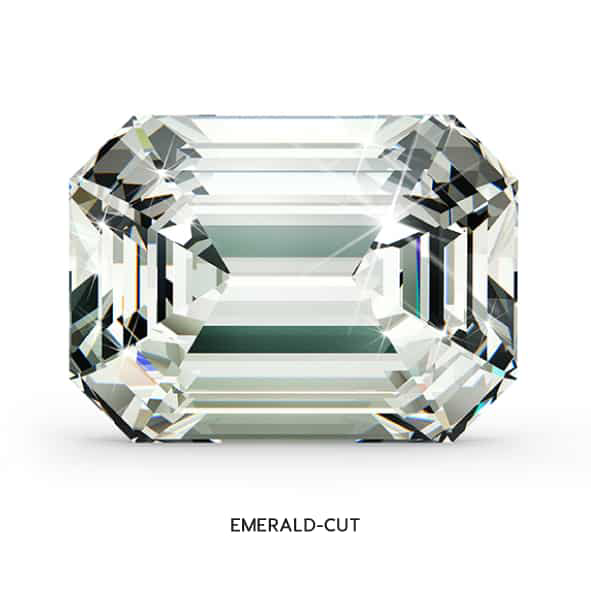
The emerald cut is a cut known to bring out the best in a diamond, when the execution of the cut is precise. This cut is often selected for diamonds with a high clarity grade, since even small blemishes would be quite visible in the large “window” facets of the emerald cut, therefore it is no wonder that emerald cuts are associated with high-quality diamonds. While the cut is lesser brilliant than cuts with triangle and kite-shaped facets, it wins by the sheer elegance of the facet alignment and precise proportions of its symmetry. The emerald cut originated by being applied to emeralds first. Later when it was discovered what stunning effect the same cut can achieve in a diamond, it became a classic cut shape for diamonds as well.
Heart Shaped Diamonds
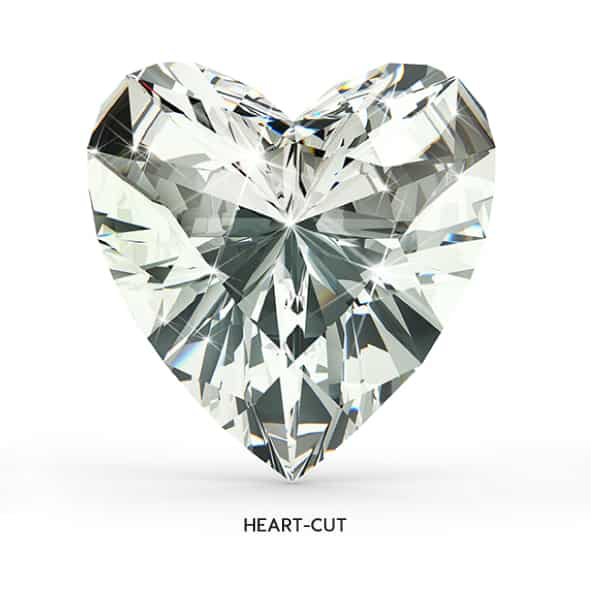
The heart shape cut features amazing brilliance and is characterized by a cleft at the top. The heart shape underlines a romantic connotation and hence makes it a popular cut for an engagement ring diamond, embodying the symbol of lifelong commitment. Symmetry is an essential attribute for a heart shape cut diamond, because only if the two halves of the diamond are identical in size and facet distribution will the diamond look attractive. It is desirable to make the split between the two lobes obvious and pronounced. The wings should have a round shape and the tip should be vertically aligned to the split at the top. Diamonds cut in the heart shape of less than .50 carat don’t present a good size-carat weight ratio; they appear small, particularly when set in prong settings.
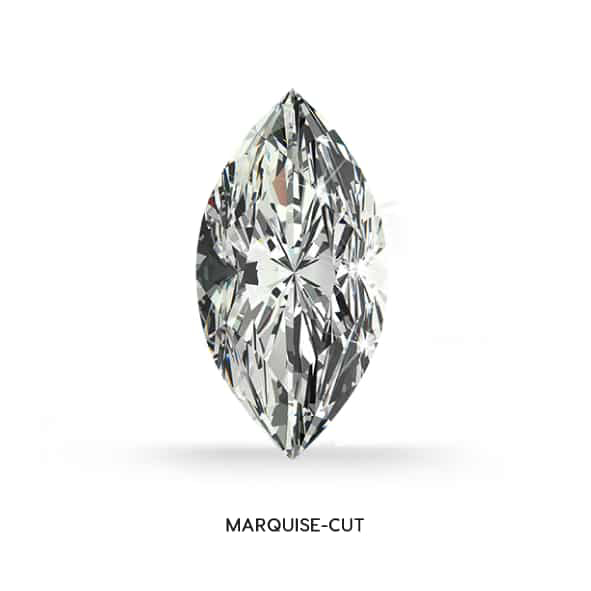
Marquise Diamonds
The marquise cut diamond, also called “navette cut” (French) is a boat-shaped, classic diamond cut. It uses a similar facet arrangement as featured in the round brilliant cut diamond, but one axis is elongated and forms the distinctive “boat shape”. Overall the cut is very suitable for maximizing the carat weight yield of a rough diamond. The marquise cut is shallow as well as big looking for it’s weight. Due to it’s elongated shape, lower color and clarity grades are more noticeable than they are in a traditional round brilliant cut diamond.
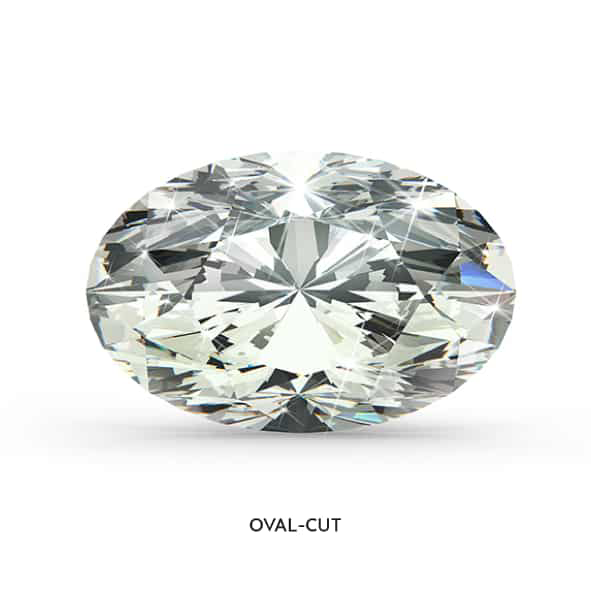
Oval Diamonds
The oval cut is very similar to the round brilliant cut, but features one elongated axis. The oval shape creates the optical illusion of stretching the finger joint and serves to make fingers and the hand look longer and more elegant. The oval cut is an ideal choice for diamond buyers, who want a diamond with a lot of brilliance, but a more unusual shape than a traditional round brilliant cut diamond.
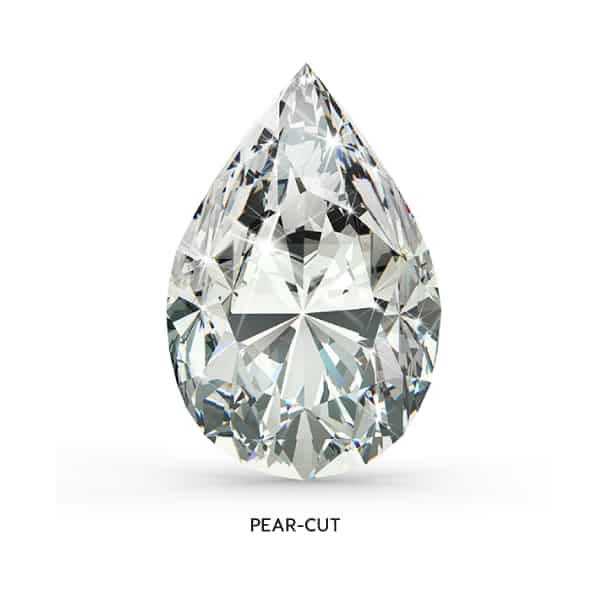
Pear Shape Diamonds
The pear cut is a combination between the round brilliant cut and the marquise cut and also belongs into the family of brilliant cut diamonds. This traditional cut is less defined in proportion that other brilliant cuts and it is available in many shape variations ranging from skinny, stretched elongated drop shapes to short and rounded teardrop shapes. Depending on the facet size and symmetry angles, a pear shape diamond might display a bow tie pattern, which is a darker area within the diamond viewed from the top. Bow ties often occur in shallow cut pear shape diamonds and are the result of finding a balance between carat weight and perceived size. Pear shape cut diamonds are very elegant and are a good match for a buyer with a taste for uniqueness and personal style that favors the uncommon.
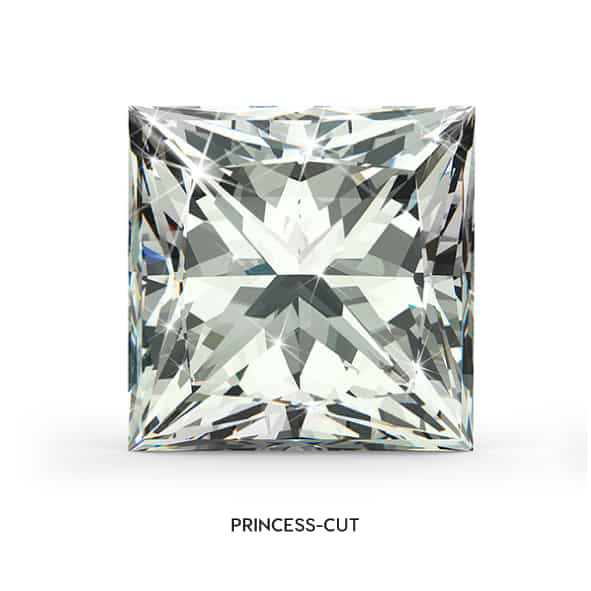
Princess Cut Diamonds
Princess cut diamonds are favored for their square shape that lends them their timeless elegance. Their square (or sometimes rectangular) shape makes them stand out from the many round and soft-cornered cuts and the remarkable brilliance that the facet arrangement produces is unmatched by any other square cut. When selecting a princess cut diamond it is important to keep the setting style in mind; which should be designed such that all four (sharp corners) are covered with metal or prongs. This protects the diamond from accidental cleavage through impact, but also avoids injuries to the wearer, as a princess cut diamonds corner is very sharp. Generally speaking, the princess cut is a very forgiving cut, which doesn’t make slight clarity characteristics or a lower color grade very obvious. For this reason a princess cut is a good option for a buyer who would like to maximize carat weight (size) and who is willing to accept a lower clarity grade or color to stay within the given budget.
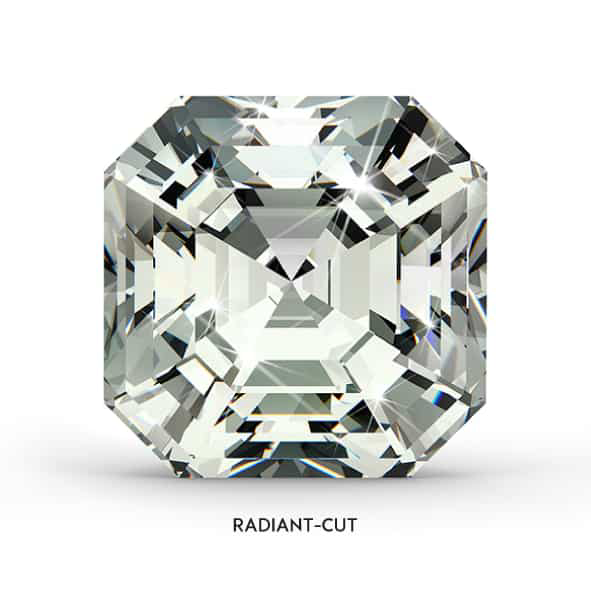
Radiant Cut Diamonds
The radiant cut combines the advantages of high brilliance and the fine elegance of a square or rectangular shape. The radiant cut is one of the best-known mixed cuts and has grown in popularity in recent years. A radiant cut is a good choice for a buyer who wants a rectangular diamond shape, but prefers more brilliance than for instance an emerald cut can provide.
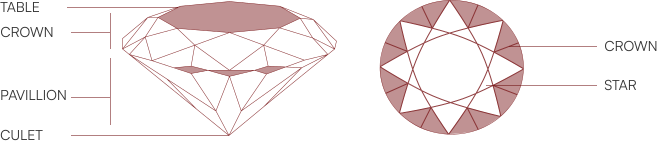
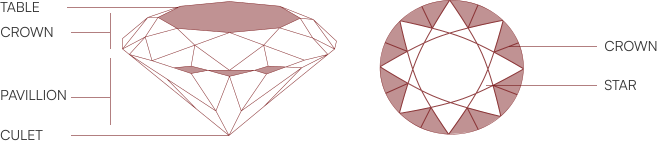
It is quite important to understand the anatomy of a diamond – or how a diamond is build. Since the proportions of the facets and their alignment in perfect symmetry are responsible for the desired effects of brightness, fire and scintillation, it is important to know, what attributes to look for in the selection of a diamond. The evaluation of the anatomy of the diamond is essentially examining all aspects of the execution of its cut.
A diamond’s structure is composed of eleven main elements: Crown, table, girdle, pavilion, culet, star facets, bezel facets, upper girdle facets, lower pavilion facets, pavilion facets:
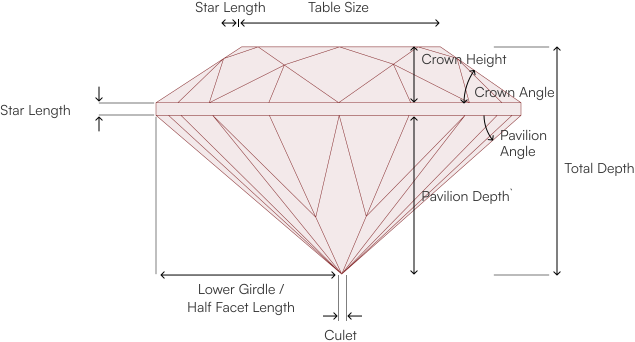
Crown: The crown is the upper portion of a diamond extending from the table to the girdle. The crown is composed of the table, the star facets, the bezel facets and the upper girdle facets
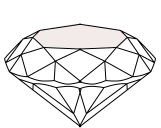
Table: The table is the main and largest polished facet located on the top of the diamond.
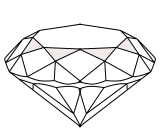
Star Facets: The star facets are those facets that are surrounding the table. Two of their sides are aligned with the bezel facets.
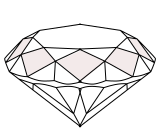
Bezel Facets: The bezel facets are those four-cornered facets that form the band of facets between the star facets and the upper girdle facets.
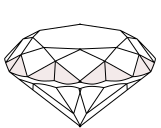
Upper Girdle Facets: The upper girdle facets are those triangular facets that are framed by the girdle and the bezel facets.
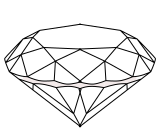
Girdle: The girdle is the mid point (circumference) of the diamond where the crown and pavilion meet.
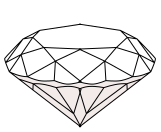
Pavilion: The pavilion is the bottom portion of a diamond that extends from the girdle down to the culet.
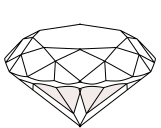
Lower Girdle Facets: The lower girdle facets are those facets that are framed by the girdle at the top and the pavilion facets to the sides.
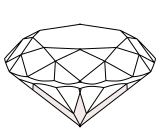
Pavilion Facets: The pavilion facets are those facets that shape the “tip” of a diamond. They all originate from one point (or facet) which is the culet.
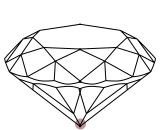
Culet: The small or pointed facet at the very bottom of the diamond.
Contents
Fancy Color Diamonds
In the evaluation of diamonds, rarity equals value. With diamonds in the regular range, value is based on the absence of color, because colorless diamonds are the most valued. Fancy color diamonds are those diamonds that are outside the normal color range. These represent the most rare and most valuable diamonds. Fancy color diamonds are found in a number of colors ranging from pink, red, yellow and blues to greens. In the value evaluation of fancy color diamonds, even very slight color differences can have a big impact on the price that they can command.
Compared to fancy yellows and browns, diamonds that feature a noticeable hint of any other hue are considerably more rare. Even in light tones and weak saturation, as long as they show color in the face-up position, they qualify as fancy colors. Green, red, and blue diamonds with medium to dark tones and moderate saturation are very rare.
Grading fancy color diamonds is complex and specialized. It takes highly trained laboratory expert to finalize the process precisely.
The fancy color grading system is designed to account for the fact that not all colored diamonds have the same depth of color. For example, yellow diamonds occur in a wide range of saturations, while blue diamonds do not.
Diamonds with red or reddish colors are immensely rare and command a high price. Pure pink diamonds are more popular than diamonds that are purplish, orangy, brownish, or grayish. Diamond marketing experts advertise some very attractive diamonds in this category as “rose-colored,” and some stones with purplish tints as “mauve” diamonds.
Blue diamonds are very rare. They mostly have a slight hint of gray, so they’re rarely as highly saturated as blue sapphires. Their color is caused by the presence of boron impurities. The higher the concentration of boron, the deeper the blue color will be.
Fancy green diamonds are mostly light in tone and low in saturation. Their color often appears sedate, with a grayish or brownish overcast. The hue is often in the yellowish green category. In most green diamonds, the hue is limited to the surface area and hardly ever reaches through the entire diamond. That is the reason why cutters try to leave as much of the natural rough around the girdle as possible as this allows more color to appear in the diamond.
Green diamonds receive their color when radiation removes carbon atoms from their regular positions in the crystal structure. Radiation can occur naturally when diamond deposits are near radioactive rocks, or induced as a result of man-made irradiation treatment.
Naturally colored green diamonds are extremely rare. Since they are so rare and it is very likely that their color has been caused by artificial irradiation, green diamonds are always regarded with great suspicion and examined extra carefully in gemological laboratories. Despite all efforts and available evaluation technology, modern gemological testing cannot always determine color origin in green diamonds for certain.
Brown is the most common fancy diamond color and also the earliest to be used in jewelry. Second-century Romans set brown diamonds in rings. In modern times, however, they took some time to become popular. Brown diamonds were typically considered only suitable for industrial use, until the 1980s, when abundant quantities of them began to appear in the production of Australian mines. The Australians made them fashionable and set them into jewelry. Promoted by diamond marketeers, who gave them names like “cognac” and “champagne”, they became a great success with diamond jewelry buyers. Today, brown diamonds are found in many medium-priced jewelry designs. Brown diamonds range in tone from very light to very dark. Diamond buyers prefer brown diamonds in medium to dark tones with a warm, golden to reddish appearance, as these present a nice color combination with yellow gold. Most brown diamonds often show a hint of greenish, yellowish, orangy, or reddish modifying colors.
Diamonds in yellow color are the most common fancy color. They are sometimes marketed as “canary.” This is however not a proper grading term, but it is commonly used in the trade to describe fancy yellow diamonds.
Contents
1. Setting Types 2. Prong Setting 3. Bezel Setting 4. Half Bezel Setting 5. Tension Setting 6. Channel Setting 7. Bar Setting 8. Pave SettingSetting Types
An engagement ring represents the style and taste of its wearer. While the selected diamond shape and size provides important attributes for the ring design, it is the setting type that defines the look and feel of the ring even further.
- When pondering the width and shape of the engagement ring, decide if you want to wear the wedding band on the same finger. If you want to wear a matched set, then the design of the engagement ring shank has to follow the shape of the wedding band.
- Consider the length of your finger joint and decide if a wider ring shank would make the diamond setting stand out more. Women with short fingers might want to consider a thinner ring style, while women with longer finger joints want to match the hand's proportions with a wider ring shank.
- Reflect if you want a simple classic solitaire, with only the gold holding the engagement diamond, or if you prefer a setting that has accent stones, which add sparkle and attention to the main diamond.
Following these initial ring-shape defining consideration, you can now select a setting style that meets your lifestyle and personality.
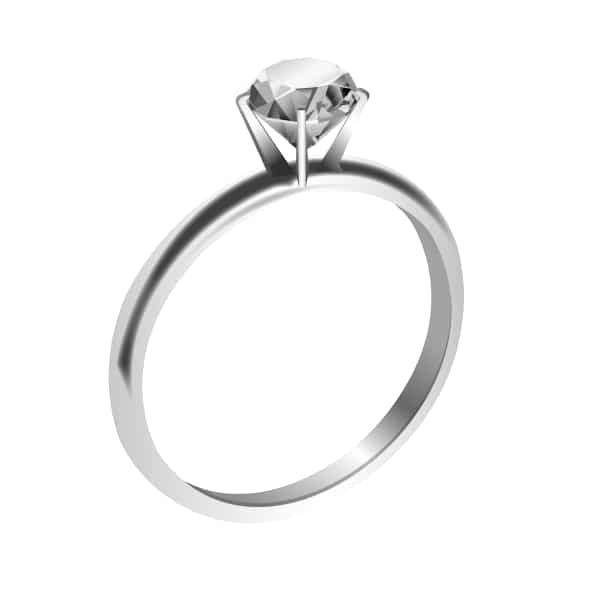
Prong Setting - Prongs represent the most classic setting technique. This setting allows the diamond to take the center stage and only four to six small claws are holding the diamond in place. The setting is constructed to minimize the appearance of gold (or platinum). Since less of the diamond is covered with metal, more light is able to pass through the diamond, which supports its brilliance and sparkle.
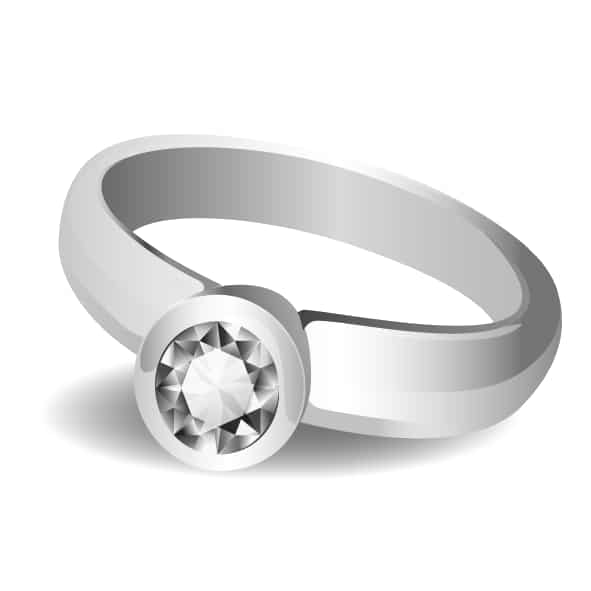
Bezel Setting - Bezel settings are cherished for their outstanding durability and their pure simplicity. A bezel setting encases the diamond in a rim of metal (gold or platinum). Since the finishing edge of the setting is completed with a “bright cut” (which is an angled, high-polished area along the edge that is cut with a graver), the set diamond will appear larger. Bezel settings can accommodate all diamond shapes and cuts and they provide the highest impact protection of any setting type.
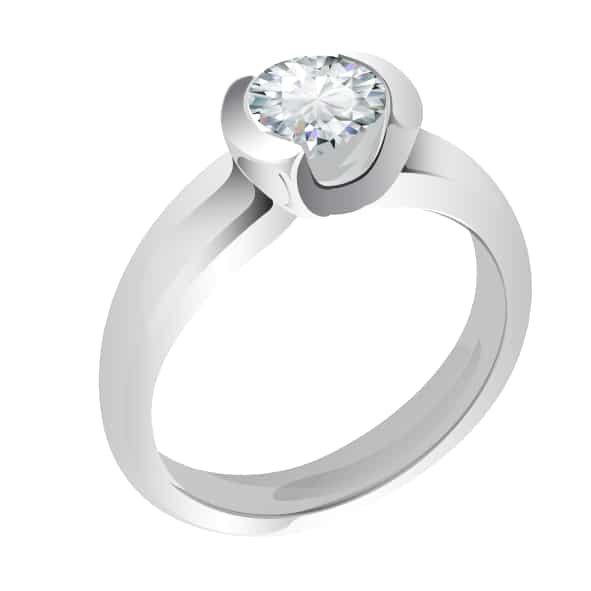
Half Bezel Setting - A half bezel setting is, as the word indicates, a partial bezel setting. It is, just like the full bezel setting, a very secure setting type, but allows more light to access the diamond. Usually the bezel walls will be placed towards the location where most impact is anticipated. The look of a half bezel setting is very contemporary and is also a popular setting type for gents rings.
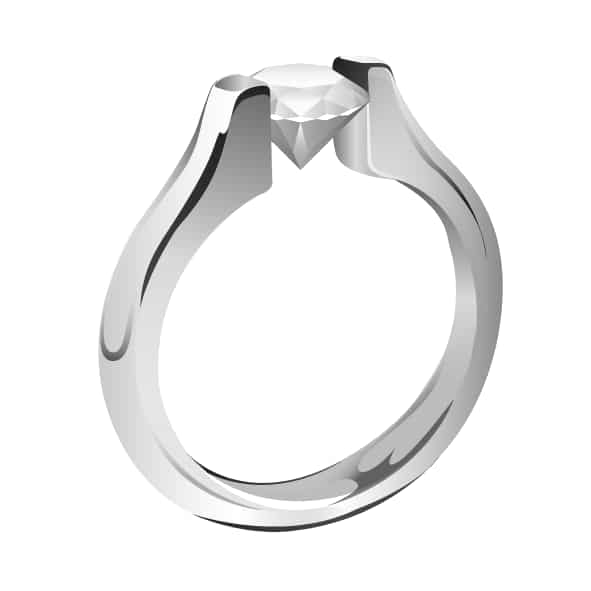
Tension Setting - A tension setting is a modern setting type that developed from the availability of more sophisticated gold and platinum alloys, which feature greater hardness and springiness. These gold alloys were launched into the market in the late 1970s and provide the opportunity to design new setting types that can hold a diamond by a great amount of tension that is created within the ring. In the application of tension settings for rings, a small grove is cut into the right and left side of a split ring shank and the girdle (the outside edge that marks the circumference of the diamond) of the diamond is “snapped” into these groves. Tension setting rings are typically wider than regular prong ring designs and they less frequently feature accent diamonds.
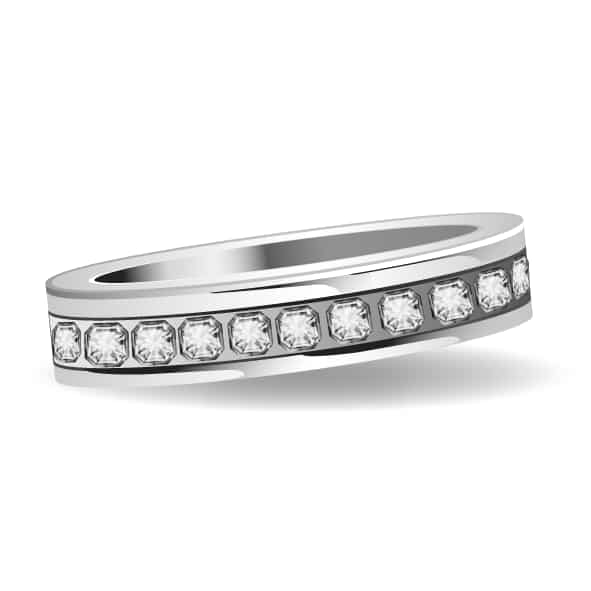
Channel Setting - Channel settings are applied to designs when there is a need for accent diamonds that are “well protected”. The basic concept of the channel setting is based on creating a row of diamonds. The diamonds are placed as close together as the girdles of the diamonds allow, subsequently this diamond row is secured by two walls, or channels, that protect the diamonds from two sides. Channel settings are particularly suitable for women with active lifestyles and those who work with their hands a lot.
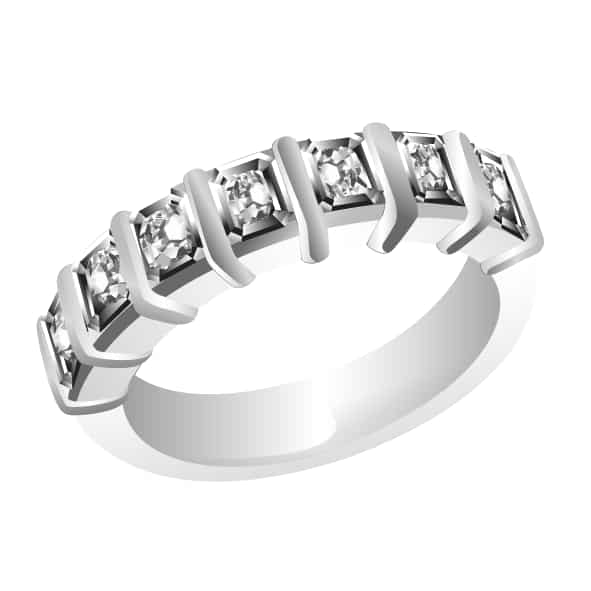
Bar Setting - As implied in the name, the bar setting is characterized by two metal bars (or one bar and one prong) that hold the diamond. The bar setting is a contemporary look that appeals to the modern woman. Since the bars are covering the diamond with less metal than for instance a bezel setting, more light can reach the diamond, which in turn supports its brilliance and sparkle.
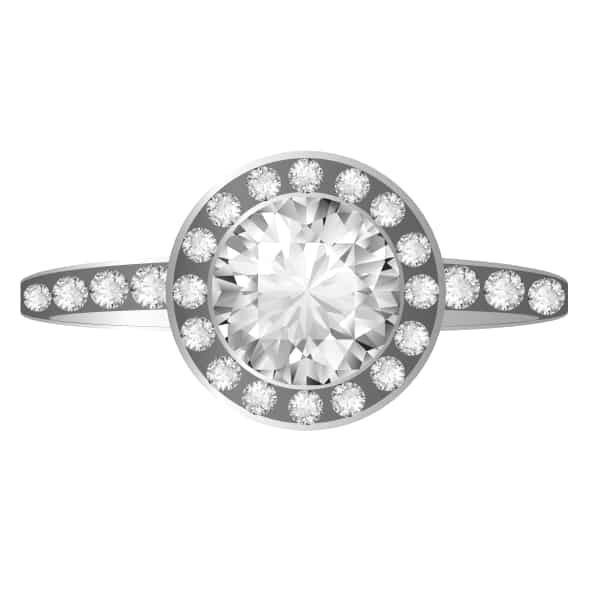
Pave Setting - Pave settings are used to set small diamonds close to each other to create the impression of a “paved” area. Pave settings are frequently used around solitaire rings to frame the center diamond.
Contents
Despite the fact that diamonds look so pristine and impenetrable, they have an uncanny affinity to grease. This property of diamonds is even used during diamond mining, when ore that contains diamond will stick to a grease belt while plain ore, that doesn’t have a grease attachment is filtered out. What this property of diamonds means to the wearer of diamond jewelry is, that diamonds will attract grease over time. This grease, combined with dust and other pollutants in the air settles around and under the diamond and diminishes it shine and sparkle. To keep your diamond jewelry as beautiful and brilliant as it was on the day you bought it, it is recommended that you clean your diamond jewelry regularly. For the cleaning treatment you can prepare a small bowl of warm water with a dash of dishwashing liquid and submerse your diamond jewelry for some minutes. If you notice some dirt accumulation that is not dissolving in the warm water on its own, you can use a small brush with soft bristles and remove the residue with a few gentle strokes. After the soap bath is completed, rinse your jewelry under running water to remove the soap film completely; then dry your diamond jewelry with a soft cloth.
Another cleaning process that is very effective is the use of small ultrasonic cleaning units that are available for cleaning eyewear and dentures. These small home-use units are either operated by electric current, or by batteries and they produce high frequency vibrations in a water bath or cleaning solution. The agitation caused by the vibration helps to dissolve grease and dirt quickly and is a very efficient way to clean diamond jewelry.
If you notice that fibers or strings got caught between the diamonds and the prongs holding them, please bring this diamond jewelry piece to your Tanishq store so that our experienced staff can confirm that the diamond is still securely set and that there is no risk of the diamond coming loose or getting lost.
During the storage of diamond jewelry it is advisable to keep it away from other jewelry pieces. Not only can the exposed facets of your diamond jewelry scratch the metal surfaces of neighboring jewelry pieces, also other softer jewelry materials, such as gemstones and pearls, can get scratched by diamonds. Even when storing diamond jewelry pieces together and apart from other jewelry, it is important to avoid that two diamond pieces touch each other. While diamonds are very hard, they can scratch each other.

Search with an image and find the same or similar jewelry.
The file size should not exceed 6 MB
File size exceeds the limit