What are Bangles? Identifying Your Signature Wrist Style
What are Bangles? Identifying Your Signature Wrist Style
August 17, 2026
-
In the archaeological record of human history, few objects are as persistent as the circle. If you were to travel back to the Indus Valley in 2600 BC, you would encounter the earliest definitive answer to the question: what is bangles? There, the "Dancing Girl" of Mohenjo-daro was discovered with bangles adorning her left arm. This wasn't merely a decorative choice; it was a structural statement of identity that has survived through centuries and into the modern day.
But, for many of us, the first time we understood the power of jewelry wasn’t in a store, but in the kitchen or the hallway of our childhood homes. It was the rhythmic "khann-khann" of our mothers’ wrists, a melodic chime that signaled her presence before she even spoke. That sound is a nostalgic anchor, a "vibration of energy" that many cultures believe wards off negativity and invites prosperity. But as we transition into curating our own collections, we often hit a technical snag: what is bangles, exactly, and why do they feel so different on the body than a flexible bracelet?
Choosing between the two is a mix of honoring that 5,000-year-old heritage and figuring out the "lifestyle friction" of our modern, active lives.
The Structural Difference
The fundamental difference is structural. A bangle is rigid. It doesn’t "drape" or fold; it holds its own architectural weight. The name itself is a phonetic legacy of the Hindi word bangri, which originally referred to a ring-shaped anklet.
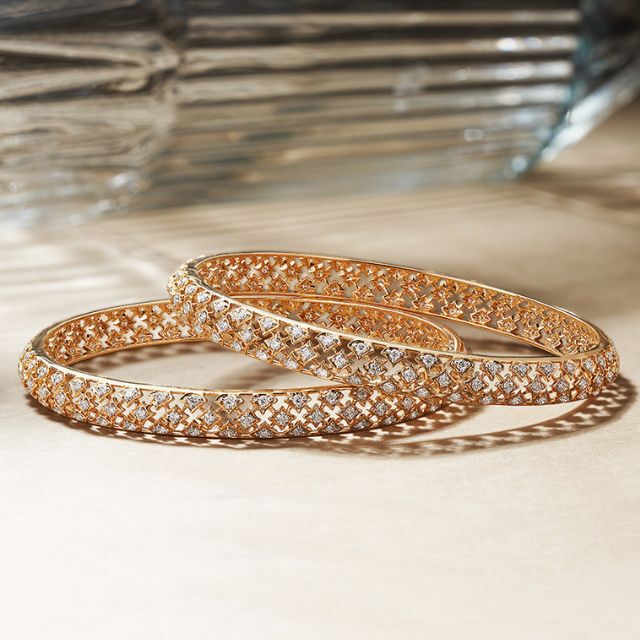
Because most traditional bangles don’t have a clasp, your size isn't determined by your wrist, but by your knuckles. You have to compress your hand to slide it on, which is why a high-quality gold bangle requires a specific level of structural integrity. When you choose gold bangles for women, you’re investing in a piece that maintains its silhouette whether it’s on your arm or resting on a marble vanity.
Bangle vs Bracelet: Why the Choice Matters
If the bangle is about continuity, the bracelet is about adaptability. Derived from the Middle French word bracaille (meaning armlet), these are built to be flexible. Whether it’s a gold chain or a diamond link, a bracelet for women is designed to conform to your wrist. Because they feature a closure, like a lobster clasp or a toggle, you get a much closer, personalized fit that isn't dictated by the size of your hand.
When the days are often a blur of typing on laptops and running errands, the bracelet is often the winner for comfort. It’s quiet and moves with you. However, bangles remain the winner for statement. They have a visual and acoustic presence that a flexible chain may not match.
A 5,000-Year Timeline of Craftsmanship
This isn’t just about fashion; it’s about archaeology. We’ve been decorating our wrists with these "circles of protection" for as long as we’ve had tools.
● The First Recorded Bracelet: Traces back to Ancient Egypt. While simple stone and shell beads appear in Egypt as early as 4500-4000 BC (Badarian culture), the iconic Scarab bracelet gained prominence later, during the Middle Kingdom (approx. 2000-1800 BC), symbolizing rebirth and protection.
● The Bronze Age Standard: In 2600 BC, the famous "Dancing Girl" of Mohenjo-daro was discovered with 25 bangles on her left arm. We’ve literally been "stacking" for four millennia.
● Ancient Purity: In the 6th-century BC city of Taxila, archaeologists found gold samples proving that ancient smiths were as obsessed with metallurgical detail as we are today.
● Material Diversity: During the Mauryan Empire, bangles weren't just gold; they were crafted from sea shells, copper, and agate, showing that the symbol of the circle was what mattered most.
The Biology of the Wrist
There’s a reason bangles are central to rituals like Valaikappu (the pregnancy ceremony). In the 7th or 9th month, a mother is adorned with various bangles, starting with a humble neem stem bangle, to create a "protective shield" of sound for the baby.
But there’s a biological layer to this, too. Traditional wellness suggests that a snug bangle stimulates the P6 (Pericardium 6) acupressure point on the inner wrist. This constant micro-friction of gold against skin is believed to improve blood circulation and help manage stress. It’s jewelry that essentially heals while it beautifies.
Knowing Your Types: Kadas, Cuffs, and Mechanics
To find your signature, you have to know the "Why" behind the design:
1.The Kada and Kangan: These are the power pieces. A Kada is a thick, solid piece (historically for both men and women). A Kangan is usually more decorative, often handed down as a family heirloom for the family’s prosperity.
2.The Cuff: An open-ended bangle. You slip it on from the side of your wrist. For the Celtic-style Torc, never pull the ends apart. This creates "metal fatigue" and will eventually snap the gold. Just slide the narrowest part of your wrist through the gap and rotate.
3.The Tennis Bracelet: A flexible, shimmering line of diamonds. It’s the ultimate for quiet luxury because it’s high-value but low-profile enough for daily wear.
4.The Sizing Rules: For a bracelet, use the Two-Finger Rule (slide two fingers under the chain to check for drape). For a bangle, a One-Finger Rule is better to ensure it stays secure while you work.
The Cultural Color Code
If you’re choosing pieces with enamel or glass, the colors carry silent messages:
● Red: Energy and prosperity (the quintessential bridal choice).
● Green: Fertility and new beginnings.
● Yellow: Happiness and spiritual strength.
Which Direction Should You Go?
Ultimately, it comes down to the moment you’re celebrating. If you want something for the office that feels like a second skin, a minimalist gold cuff or a link bracelet is the move. If you’re heading to a wedding or a milestone event, bangles for women are the most evocative way to honor tradition.
The most modern way to wear them? The “fusion" stack. Mix a rigid, traditional gold bangle with a flexible, contemporary diamond bracelet. It bridges that 5,000-year history with the reality of your current life. You aren’t just wearing a piece of metal; you’re carrying a lineage of craftsmanship that has survived everything history could throw at it.

Search with an image and find the same or similar jewelry.
The file size should not exceed 6 MB
File size exceeds the limit