How to Pick the Perfect Wedding Band
How to Pick the Perfect Wedding Band: Tips for Choosing the Best Bridal Jewelry
August 12, 2026
-
Buying a wedding band is one of those rare moments where deep sentiment meets exceptional craftsmanship. While an engagement ring captures a "yes," the wedding band is the part that actually does the heavy lifting. It’s a functional heirloom, a piece of jewelry that needs to survive decades of daily life without losing its integrity.
If you want a ring that balances that "sparkle factor" with actual durability, you have to look past the velvet box and check the specs. Here is an essential guide on how to pick a wedding band that’s built to last as long as the marriage.
1. The Visual Profile: To Match or Not to Match?
The first big question is how the band plays with your engagement ring and your overall bridal jewelry suite. You generally have three paths:
● The Seamless Set: Many high-end jewelers design "interlocking" sets where the diamond heights and metal widths match perfectly. It’s symmetrical, classic, and looks like a single, cohesive unit.
● The Custom Curve (Shadow Bands): If your engagement ring has a unique shape, like a pear or a low-set basket, a straight band won't sit flush against it. A contoured band is custom-curved to hug the silhouette of your stone.
● The Mixed Stack: Lately, the matching rule has gone out the window. Mixing metals like a platinum engagement ring with a rose gold band, gives the stack texture and lets the wedding band stand out as its own piece.
2. The Science of the Metal
When exploring different gold ring designs, choosing a metal isn't just about the color, it’s about how much maintenance you’re willing to do.
● Platinum vs. White Gold: They look identical on day one, but age differently. Platinum is dense and develops a matte "patina." White gold is harder and more scratch-resistant, but requires "re-dipping" every 2 years to keep it from yellowing.
● 14k vs. 18k Gold: 14k gold has more alloy metals mixed in, it’s more rigid. 18k gold is "richer" and more prestigious, but it’s softer.
3. Understanding the Different Types of Wedding Rings
How the diamonds are held in place determines how often the ring will get caught on your sweaters or, worse, lose a stone. There are several types of wedding rings based on their security:
● Channel Setting: The stones are tucked between two walls of metal. This is incredibly secure and perfect for an active lifestyle.
● Pavé Setting: These are those tiny, shimmering diamonds held by microscopic prongs. They look like a field of sparkles, but they are delicate. A hard knock against a table can easily dislodge one.
● Bezel Setting: Metal completely surrounds the edge of the stone. It’s sleek, modern, and hygienic because it reduces trapping of lotion or dust.
4. Don't Skip the "Comfort Fit"
The most important technical detail for your daily sanity is the interior profile. Traditional rings are flat on the inside. A comfort fit ring has a slightly domed, curved interior. This reduces friction against your skin and makes a world of difference if your fingers swell due to heat or humidity.
5. The Eternity Band Reality Check
A full eternity band (diamonds all the way around) is a dream for many looking at types of rings for marriage, but it comes with two warnings:
1.You can't resize it: There’s no plain metal to cut into. If your finger size changes, you’re looking at a full replacement.
2.The "Palm-Side" Problem: The bottom of your hand hits everything like steering wheels, door handles, desks. Diamonds on the bottom are much more likely to crack or fall out.
The Pro Move: Go for a 3/4 or Half-Eternity band. You get the full-diamond look from the top and sides, but the bottom is solid metal.
6. Coordinating Your Wedding Look
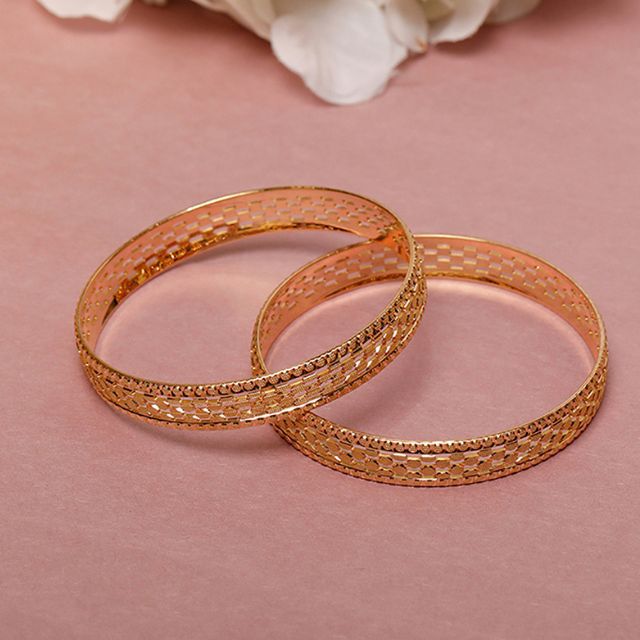
While your focus is on the finger, remember that your band should harmonize with your broader bridal jewelry. For example, if you are wearing a statement necklace set for women or traditional bangles, you may want a band that echoes those metal tones or motifs.
Whether you are looking at classic or modern types of wedding rings, always check the small diamonds (called "melee"). For a high-end look, aim for G-H Color and VS1-VS2 Clarity to ensure they match the quality of your center stone.
7. Timeline and Final Steps
When choosing various types of rings for marriage, don’t wait until the final month. A quality, custom-sized band usually takes 4 to 6 weeks to manufacture. Give yourself an 8-week buffer to avoid any last-minute stress.

Search with an image and find the same or similar jewelry.
The file size should not exceed 6 MB
File size exceeds the limit